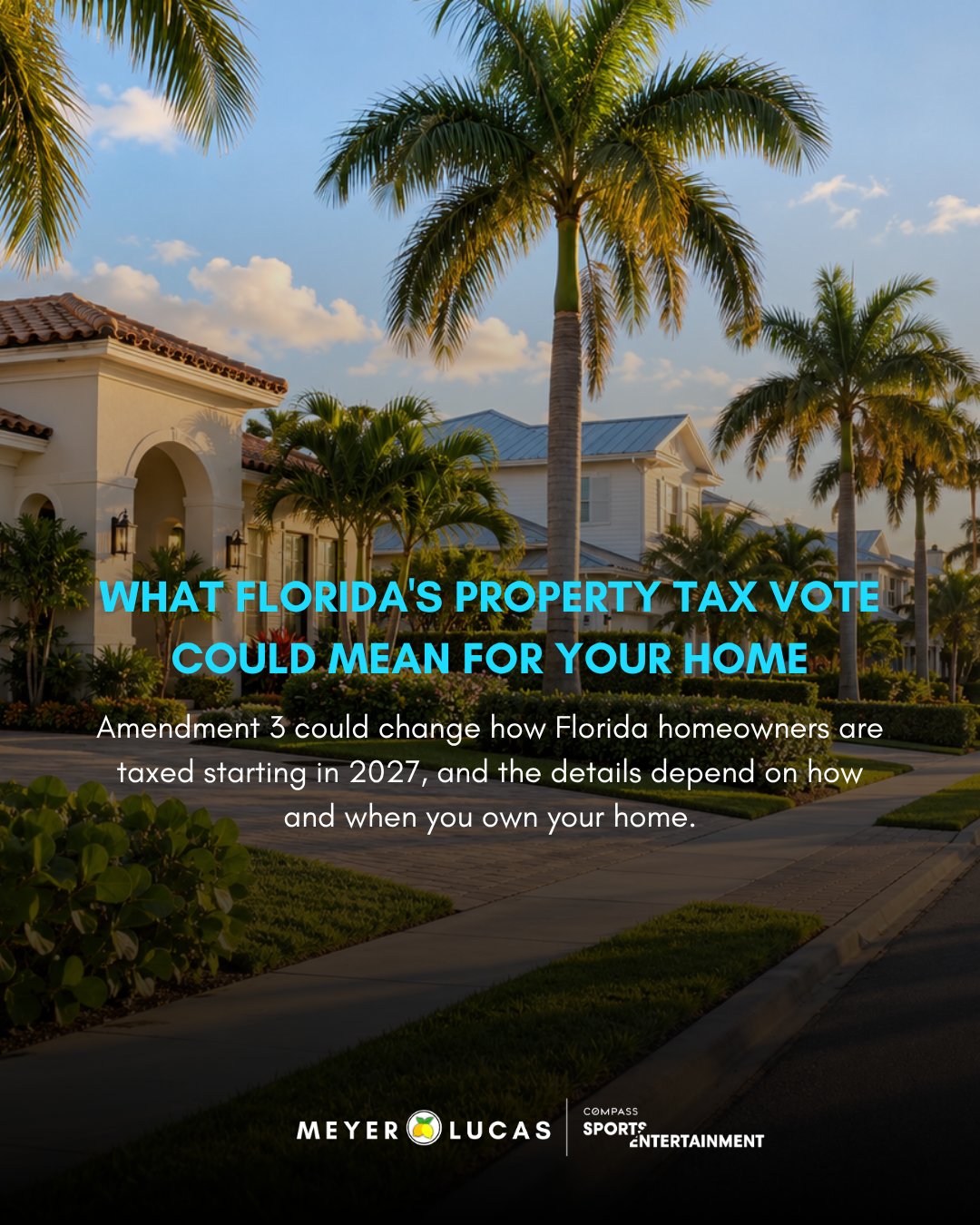
If you own a home in Florida, there's a question on your Nov. 3 ballot about your property taxes. It's called Amendment 3, and it would give homeowners a larger tax break on the home they live in full time, starting in 2027. This guide explains what the amendment would do in everyday terms, who it would apply to, and where Palm Beach County homeowners can look up what it might mean for their own property. It doesn't tell you how to vote. That part is up to you.
What Is Amendment 3, in Plain English?
Amendment 3 is a proposed change to the Florida Constitution that the state Legislature put on the ballot this year. Its main purpose is to increase the homestead exemption, the tax break Florida gives people on their primary home.
If voters approve it, the part of your home's value that's shielded from most property taxes would grow from about $50,000 today to $150,000 in 2027 and $250,000 in 2028, and then keep pace with inflation after that. The amendment also includes a few other changes, covered below, for second homes, people new to Florida, and how cities and counties can spend property tax money.
For the amendment to pass, at least 60% of voters have to vote yes.
What Is the Homestead Exemption?
If you own a home in Florida and it's your permanent residence, you can apply for a homestead exemption. It lowers the taxable value of your home, which lowers your tax bill. It also comes with a cap, known as Save Our Homes, that limits how much your home's assessed value can go up each year, no matter how much the market rises. That cap stays at 3% (or the rate of inflation, if lower) whether or not Amendment 3 passes.
You only apply once. In Palm Beach County, applications go to the Property Appraiser's Office, and the deadline is March 1 of the year you want the exemption to start.
How Would Amendment 3 Change My Property Tax Bill?
Your property tax bill is a combination of taxes for your public schools and taxes for everything else: your county, your city, and local districts that handle things like fire rescue, parks, and water management. Amendment 3 would only increase the tax break on the "everything else" part. School taxes would work the same way they do now.
A simple example: say your home has an assessed value of $500,000. Today, your county and city taxes are figured on about $449,000 of that value. If Amendment 3 passes, that number would drop to $350,000 in 2027 and $250,000 in 2028. Your school taxes would still be based on $475,000, the same as now.
How much you'd save in dollars depends on where you live, because every city and county sets its own tax rates. A home in Jupiter and a home of the same value in Palm Beach Gardens could see different results.
Would My Property Taxes Go Away Completely?
For most homeowners, no. Palm Beach County Property Appraiser Dorothy Jacks has called this one of the most common misunderstandings about the amendment. School taxes would still apply, and so would flat fees that show up on many tax bills, such as trash collection. Homes with a lower assessed value could see the county and city portion of their bill drop to zero, but the school portion would remain.
The amendment also asks the Legislature to create a process that would let counties and cities go further in the future and exempt homes from their taxes entirely. It doesn't set a date for that, so nothing about it would happen automatically.
Does Amendment 3 Affect Second Homes and Rental Properties?
The larger tax break only applies to a primary residence. Second homes, seasonal homes, rentals, and commercial property wouldn't qualify for it.
Owners of those properties would see a different change that works in their favor. Today, the taxable value of a second home or rental can go up as much as 10% a year. Amendment 3 would lower that limit to 5% a year, which slows how fast those tax bills can rise.
I'm Thinking About Moving to Florida. Does This Affect Me?
It could, and the timing is worth understanding. Anyone who buys a home in Florida and makes it their primary residence still qualifies for the homestead exemption and the Save Our Homes cap, as they do today. What Amendment 3 changes is when newer residents would get the larger version of the tax break.
Under the official ballot summary, people who aren't Florida residents by Dec. 31, 2026, would start with the current exemption and move up to the larger one in their fifth year. The summary adds that this waiting period applies only "to the extent permitted by the U.S. Constitution." Florida TaxWatch points out that the Florida Supreme Court struck down a similar five-year wait in 1982, so whether this part would hold up is an open legal question.
If you're planning a move to Jupiter or elsewhere in Palm Beach County, this is a good topic to bring up with your agent and a tax professional as you think through timing.
I Already Live in Florida. What If I Sell and Buy Another Home?
The five-year waiting period is tied to when you became a Florida resident, not to when you bought your current home. Under the ballot summary, people who are Florida residents by the end of 2026 and later move to a different Florida home would still be eligible for the larger exemption when they homestead the new property.
Florida homeowners who move within the state can also use portability today, which lets you carry some or all of your Save Our Homes savings to your next homestead. That option exists under current law and isn't part of Amendment 3.
Why Does the Ballot Wording Look Different From What I've Heard?
You may have seen Amendment 3 described as "Save Our Homes From Excessive Property Taxes." That was its original title. In August, a Leon County judge ruled that the original wording was misleading, and the state rewrote it. The official title on your ballot is now "Increased Homestead Exemption; Lower Cap on Increases in Non-Homestead Property Assessments." The amendment itself didn't change, only the description voters see. You can read the full official summary on the Florida Division of Elections website.
The official summary also includes a provision on local spending. It would require counties and cities to use property tax money for a set list of purposes, including public safety, schools, infrastructure, and natural resources, while still allowing local officials to approve other spending unless state law prohibits it.
How Can I See What Amendment 3 Would Mean for My Home?
The Palm Beach County Property Appraiser's Office has a free Amendment 3 Homestead Calculator on its website. If you already have a homestead exemption, you can search your address and see an estimate of how your taxes could change, based on this year's values and tax rates. The calculator also shows the estimated effect on local governments. The Property Appraiser's Office has said it isn't taking a side on the amendment.
If you own in Martin County, including Hobe Sound, Stuart, and Palm City, the Martin County Property Appraiser's Office is the best source for local figures.
What Are Supporters and Opponents Saying?
Supporters, including Florida Realtors, say the amendment would give homeowners meaningful tax relief and help keep homeownership within reach. Groups representing counties and sheriffs have raised concerns about how a smaller tax base would affect local services such as emergency response. The campaigns on both sides publish their arguments at Vote Yes on 3 and Vote No on 3.
Key Dates for Palm Beach County
- Monday, Oct. 5, 2026: Last day to register to vote in the general election
- Oct. 19 through Nov. 1: Early voting in Palm Beach County, 7 a.m. to 7 p.m.
- Thursday, Oct. 22, 5 p.m.: Last day to request a mail ballot
- Tuesday, Nov. 3: Election Day, 7 a.m. to 7 p.m. Mail ballots must arrive at the Supervisor of Elections by 7 p.m.
- Dec. 31, 2026: Florida residency date that matters for the larger exemption
- Jan. 1, 2027: Amendment takes effect if approved
- Jan. 1, 2028: The larger exemption reaches its full amount
Early voting locations and sample ballots are available from the Palm Beach County Supervisor of Elections.
Quick Answers
Does Amendment 3 lower school taxes? No. The school portion of the homestead exemption stays at $25,000.
When would the change start? If voters approve it, the first increase would apply in 2027 and the full increase in 2028.
Do I need to do anything if it passes? If you already have a homestead exemption, it renews automatically each year. If you don't have one yet and the home is your primary residence, apply with your county property appraiser by March 1.
Does it affect the Save Our Homes 3% cap? No. That cap on primary homes stays the same.
This article is for general information and isn't legal or tax advice. For figures on a specific property, contact your county property appraiser or a licensed tax professional.
Property Taxes and Your Next Move
Property taxes come up in almost every conversation we have with buyers moving to Jupiter and Palm Beach Gardens, and with homeowners here deciding when to sell and where to go next. Whatever voters decide on Nov. 3, the biggest factors in a home's tax bill will still be whether it's your primary residence, when you file for homestead, and when you became a Florida resident. We're glad to walk through how those pieces apply to a home you're considering and point you to the official sources for the numbers.
The Meyer Lucas Team serves buyers, sellers, relocators, and investors throughout Jupiter, Palm Beach Gardens, North Palm Beach, Juno Beach, Tequesta, West Palm Beach, Palm Beach County, and Martin County.
📞 Call or Text: 561-406-5228
📩 Email: [email protected]
🌐 Learn more and meet the team: meyerlucas.com
🔍 See homes for sale: Home Search